We have a tendency to forget that while acquiring a new customer cost fortunes, retaining an existing one is both cheaper and better business. Data shows that a five percent increase in retention can boost profits on a regular eCom by 25 to 95 percent.
And sure, we have plenty of loyalty programmes out there…
But most of them are built backwards. They reward transactions —> money spent. But they overlook one of the most valuable brand currencies out there: Time! For high-end brands, that logic has always been a fact, but in a digital eCom space, we tend to forget that online shopping also forges a relationship, if done right.
So what am I getting at?
The brands that get loyalty right don't think of it as a programme at all. They think of it as a core of their business: a way of looping their clients in, a system for recognising, learning from, and deepening relationships with the ambassadors that push the brand forward. Not through points and cashback, but through relevance, access, and genuine connection.
This article breaks down how high-end ecommerce brands can build loyalty programmes that strengthen both brand and business.
The business case for loyalty programmes
The economics of retention are well-established but still routinely ignored. Acquiring a new customer costs five to 25 times more than retaining an existing one. And roughly two-thirds of consumers feel brands care more about winning new customers than keeping existing ones.
For high-end ecommerce, the numbers are even more compelling. Loyal customers generate 40 percent of online store revenue . They have a 60 to 70 percent likelihood of purchasing again, compared to five to 20 percent for new customers. And loyalty programme members generate up to 18 percent more revenue annually than non-members.
But the most powerful metric for high-end brands is emotional, not transactional. Customers with a strong emotional connection to a brand have a lifetime value 306 percent higher than merely satisfied customers.
Your loyalty programme doesn't need millions of members. It needs the right members.
Loyalty programmes as first-party data infrastructure
There's a second business case that most brands underestimate: the data.
As third-party cookies disappear, loyalty programmes are becoming the most valuable source of first-party and zero-party data a brand owns. Every interaction, what a member browses, saves, buys, redeems, ignores, generates signal that can train personalisation, inform product development, and sharpen marketing spend.
Ulta Beauty treats its 46.7 million-member loyalty programme as the engine of its AI personalisation strategy. Every data point feeds recommendations, automated marketing sequences, and even conversational AI for customer service.
For high-end ecommerce, the implication is clear: the loyalty programme isn't just a retention tool. It's a research platform. It tells you what your customers want before they tell you themselves, if you design it to listen.
And the willingness is there: 91 percent of consumers say they'll share personal preferences with a brand in exchange for more personalised rewards. That's an extraordinary level of data consent. But it comes with an obligation to deliver genuine value in return.
What consumers (don’t) want
Loyalty programme membership has never been higher, but actual engagement is declining. More than 35 percent plan to cancel at least one membership in the next year. The competition isn't for membership. It's for one of the few slots in a customer's active portfolio.
What earns that slot:
Personalised, immediate value. Offering instant rewards rather than requiring months of accumulation can increase basket sizes by 36 percent . 78 percent of consumers are more likely to repurchase from brands that personalise their experience, and 74 percent say tailored offers make them shop longer and spend more .
Exclusive access and recognition. 93 percent of consumers say they'd join an exclusive experience offered only to loyal customers. Over 60 percent of high-net-worth consumers expect luxury brands to recognise them as individuals, not just buyers.
Simplicity. Consumers want choice, but not complexity. Limiting reward options to two or three relevant choices dramatically increases redemption rates.
What doesn't work anymore:
Generic points systems. About 70 percent of consumers say the perceived value of loyalty points has dropped . 45 percent are dissatisfied with how long it takes to earn rewards.
Complexity for its own sake. 83 percent of businesses already struggle with engagement . Adding layers of rules, conditions, and earning mechanics only widens the gap.
Discounts that erode brand value. For high-end brands, cashback and percentage-off rewards risk devaluing the very thing customers are loyal to. The most effective programmes at the premium end offer experiences, recognition, and access, not coupons.
How to use tiers in your programme
Tiered structures work because they tap into something psychological: when a customer sees a ladder, they want to climb it. Tiered programmes deliver 1.8 times higher ROI than single-tier structures , with 50 percent of members changing their behaviour to reach new tiers. VIP-tier members generate 73 percent higher average order value and make 3.6 times more annual purchases.
But tiers must be designed carefully - especially for high-end brands.
The problem with spend-based tiers
Most tier systems are based on annual spend. It's simple and easy to communicate. But for high-end ecommerce, it's a flawed proxy for loyalty.
A customer who buys one expensive item per year may qualify for a top tier without any meaningful ongoing engagement. Meanwhile, a customer who purchases regularly, engages with content, refers friends, and genuinely advocates for the brand might sit in a lower tier because their individual transactions are smaller. Spend measures wealth. It doesn't measure loyalty.
We believe high-end brands should move away from spend as the primary tier indicator. The better metrics are repeat purchase frequency, engagement and advocacy, e.g. content interaction, event attendance and referrals. Behaviours that actually signal a deepening relationship.
This doesn't mean spend is irrelevant. But it should be one input among several, not the defining one.
Lessons from Cecilie Bahnsen
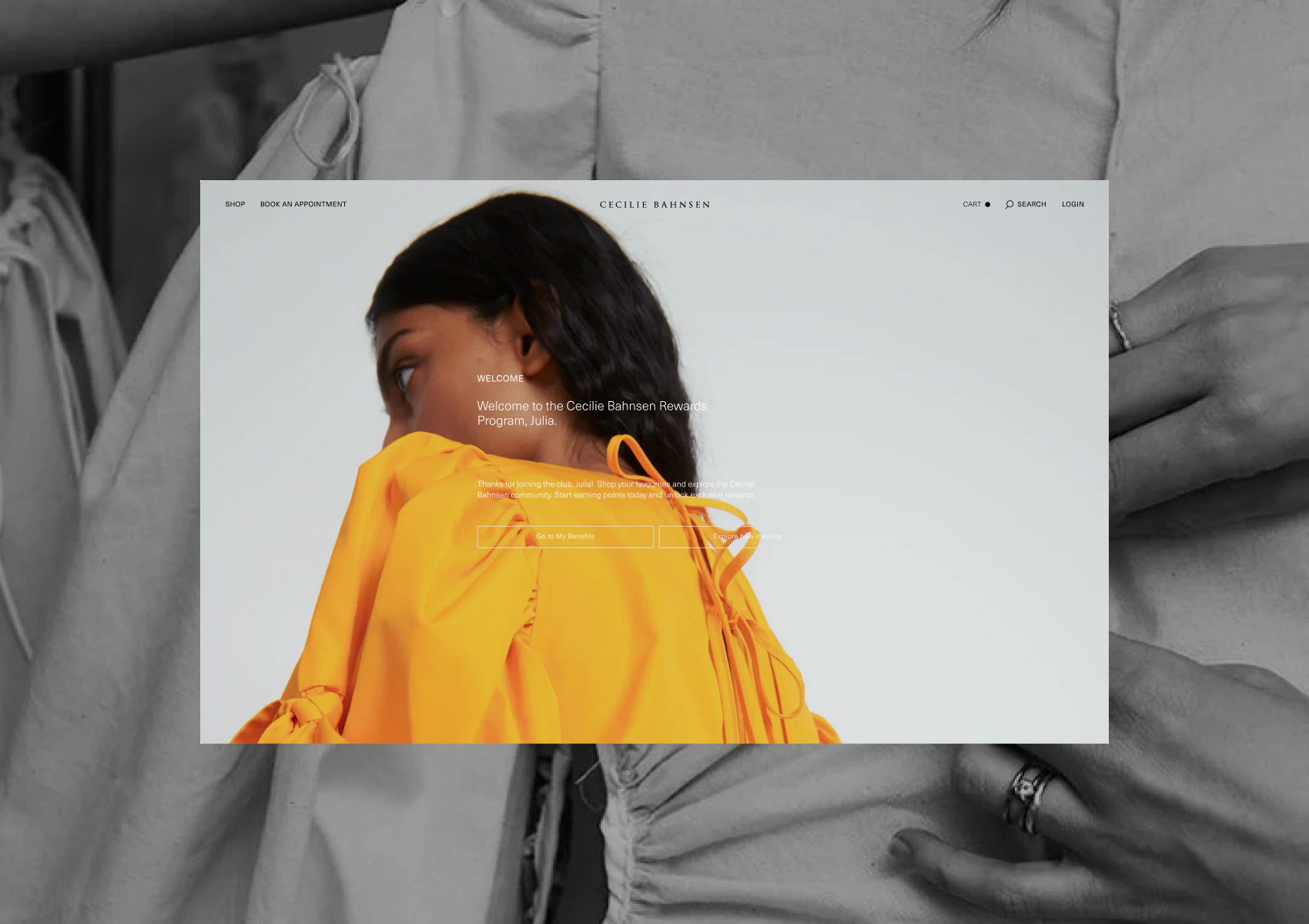
When we worked with Cecilie Bahnsen on their loyalty programme, tiers served a specific strategic purpose. As Signifly Senior Strategist Gabrielle Olivas explains: “The tiered structure was designed to give all community members a space for personalised recommendations, guidance, and content. But it also allowed them to give extra love to their most engaged super fans.”
Cecilie Bahnsen already had a community. Their customers don't just buy the clothes, they care about the designer, the craft, the world behind the brand. The loyalty programme didn't need to create engagement from scratch. It needed to take what already existed and make it structured and scalable.
For Cecilie Bahnsen, we used spend-based tiers because it was the simplest metric to undestand, internally and externally. But the ambition is to continue to reward behaviours like purchase frequency and engagement. Spend was a pragmatic starting point, not an ideological commitment.
The tier structure also shaped what content and access each level receives. Rather than layering on gamification elements like point bars and progress trackers, which can feel at odds with a luxury brand's tone, we focused on making the programme feel like a personal space. Something you return to, not something that nudges you.
Benefits were primarily early access and exclusivity: sneak peeks at upcoming products, behind-the-scenes content on how items are made, care instructions, and a personal wishlist. These aren't rewards in the traditional sense. They're extensions of the brand experience.
Design principles for high-end tiers
The best tier structures for premium brands follow a few principles:
Make every tier feel valuable. If tier one feels like a waiting room for tier two, you've lost. Each level should offer genuine access and recognition, even at entry level. Net-a-Porter's evolution from a secretive, invite-only EIP programme to a visible tiered structure (Bronze through Platinum EIP) shows how even ultra-premium brands benefit from giving every customer a clear entry point and a reason to stay.
Make progression feel achievable. If the distance between tiers feels impossible, the structure collapses into a single tier in practice. FARFETCH Access uses five tiers from first purchase up to $15,000 annual spend, with meaningful benefits at each step, from early access at Silver to a full Fashion Concierge service at Private Client.
Start invisible, then reveal. You can design and test tier thresholds in the background before communicating them externally. Observe actual customer behaviour at each level, then set thresholds that reflect real purchasing patterns rather than arbitrary targets.
Use tiers to inform, not just reward. The most valuable function of a tier structure is the behavioural data it generates. Who is on the cusp of the next tier? Who dropped? Who engages without buying? These patterns tell you where to invest attention, and they feed directly back into your data infrastructure.
Focus on the personal, not the transactional
For high-end ecommerce, the most effective loyalty programme is one that doesn't feel like a programme at all. It feels like a relationship.
Gucci's MY GUCCI membership illustrates this philosophy. There are no points to accumulate. Instead, the programme uses purchase history, a preference centre, and both zero-party and first-party data to build a personalised shopping experience: tailored recommendations, early access to limited collections, AR try-ons, personalised video consultations with stylists, and surprise gifts. The relationship is the programme.
At the other end of the spectrum, the ultra-luxury houses operate loyalty through deliberate opacity. Hermès has no official programme , loyalty is rewarded through controlled scarcity and quietly extended privileges. Chanel focuses on deep personal relationships with high-spending clients through private viewings and fashion show invitations. Cartier's Le Cercle is invitation-only, offering access to private events and personalised design consultations that are never publicly advertised.
The principle that unites these approaches: the programme should feel like it knows you, not like it's tracking you.
What this looks like in practice
For the Cecilie Bahnsen programme, the initial concept was built around a "personal shopping experience" - how to translate the intimacy of physical retail into a digital space. Not a rewards programme. A personal space.
That meant being a source of inspiration for the customer's style in general - not just selling products. It meant telling the story of how items are made, strengthening the connection between the brand and Cecilie Bahnsen herself, and creating a space where customers could learn how to care for their clothes. Content that builds a world, not content that pushes a sale.
The ambition for the next phase is to make this connection two-way: community feedback that lets customers be part of the design process, community events, and eventually social connections between people who share an interest in CB. The programme becomes a living relationship between brand and customer, not a ledger of transactions.
The practical takeaway for any high-end brand: design the programme around the question "What would make this customer feel recognised and inspired?", not "What would make this customer spend more?" The spending follows the relationship. It rarely works the other way around.
Questions to pressure-test your programme
Whether you're building from scratch or evaluating what you have, these seven questions cut to what matters:
1 – Does your programme extend your brand or contradict it? If the tone, mechanics, or rewards feel disconnected from how your brand presents itself everywhere else, customers will notice. A loyalty programme for a high-end brand should feel like the brand, not like a generic rewards layer bolted on top.
2 – Are your tiers measuring loyalty or just wealth? If a single high-value purchase can catapult someone to your top tier while a frequent, engaged customer stays at the bottom, your structure rewards transactions, not relationships. Consider whether repeat purchase frequency, content engagement, or advocacy would be better indicators.
3 – Can every tier justify its own existence? If your entry tier feels like a waiting room and the top tier feels unreachable, you effectively have a single-tier programme. Each level should deliver value worth staying for, and progression should feel achievable.
4 – Is the value you offer immediate or does it require months of patience? Programmes that demand long accumulation before delivering anything meaningful are losing relevance. If a new member can't see the benefit within their first interaction, reconsider your reward structure.
5 – What does your programme data actually tell you and who uses it? A loyalty programme generates first-party data on preferences, behaviour, and engagement. If that data sits unused in a dashboard, you're running a cost centre. If it feeds product development, content strategy, and personalisation, you're running infrastructure.
6 – Are you designing for your most valuable customers or your average ones? The programme should be built around the customers who matter most to your business. If you're optimising for mass participation rather than deep engagement, you may be attracting the wrong behaviour.
7 – How does the programme stay alive after launch? Seasonality, editorial content, new access tiers, community events, the best programmes evolve. If there's no plan for what the programme looks like in six months, it risks becoming background noise.
The best loyalty programmes aren't launched and left. They're built to learn.